OUR HOUSE ….. an Overview
HISTORY OF KEN AND HARRIET’S HOUSE:
At 1606 CHAMBERS FLAT RD ……
…. As at 1981 – 2009 = 28 years on …..
….. How to build a house for $A31,000.00 in 1981 and buy 5 acres of land for $A13,00.00 in 1977 ……
Where does House, Garden and Bush End?
__________________________________________________


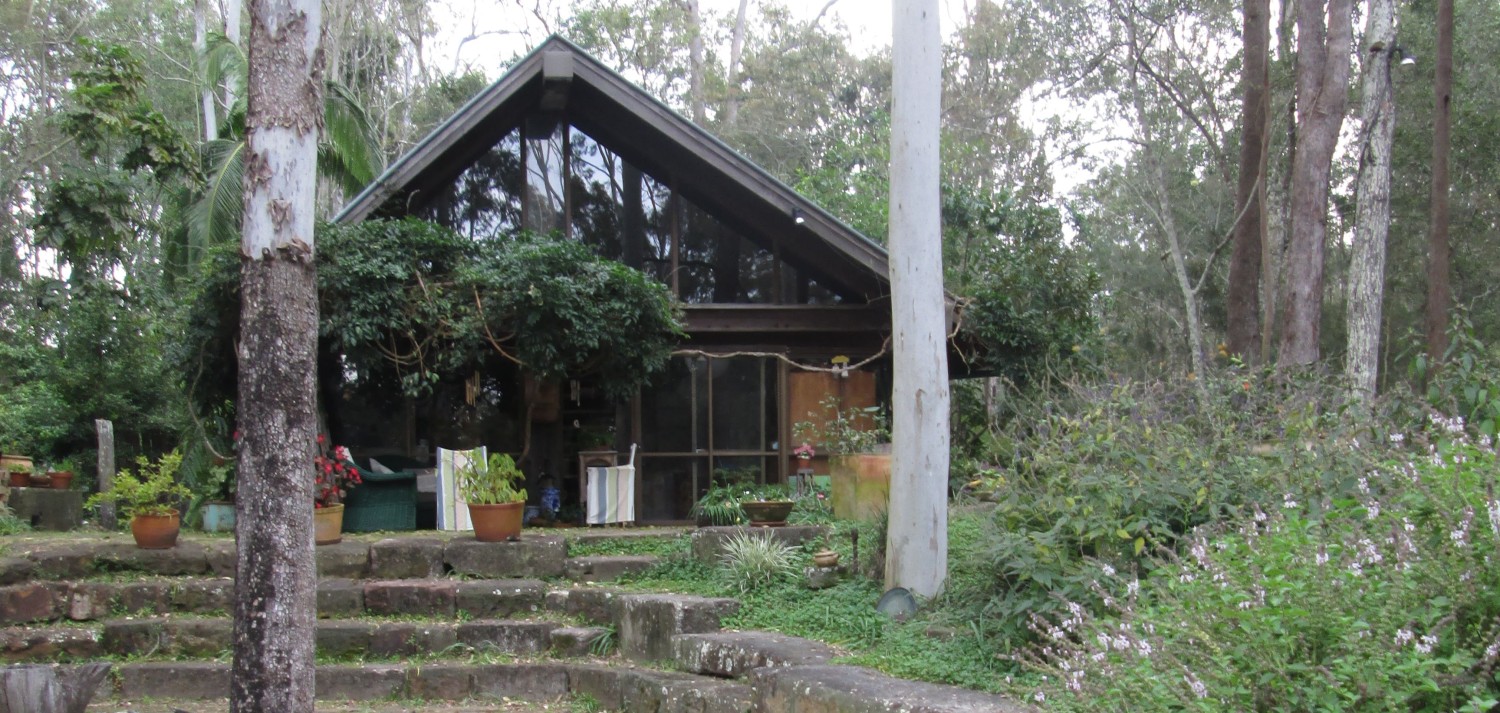
The first photograph shows the Amphitheatre in front of the house. The next few photographs shows the interior of the house … the stone wall of the living room, the bricks on the floor, the big beams, the glass windows looking into the bush, the red cedar timber doors, vertical timber walling and undressed cypress pine ceiling.
___________________________________________
HISTORY – 1977 to 2009: We live in a special house built largely of demolition timber and stone, built twenty seven years ago in 1981 for a fraction of the cost of a new house. Some of the stone is very old from the late 1800’s. Australia as a whole was only settled after 1788. Compared other countries, the 1800’s is very old to us. The house is on five acres of light open Australian bush which we bought very cheaply when we came out to our bush block in 1977 ….. four years earlier. We were way out thirty five kms. south of Brisbane then in the countryside. Now we are in the middle of everything …. not that we want to sell. Acreage land has become very valuable around us now.
We initially came here to Chambers Flat in 1977 after spending the first two years of our married life in a small rented cottage at Taringa, one of the suburbs of Brisbane for $A25.00 / week from some older friends. In those days, the area was still very much bush. We came to this bush block where wallabies grazed on the side of the road down around the corner. Across the road, was a 1000 acres of bush with no houses whatsoever. Trees crowded and overhung the narrow road which had been an early stock-route from Beaudesert to Waterford / Beenleigh in the late 1800’s.
Right from the beginning, I had a dream to build a house that seemed as though it had grown up from the ground. We had an architect friend draw some initial plans. With more discussion, the plans were changed to accommodate demolition stone, beams and bricks which had been recently been acquired. The idea was to create a total concept where bush, house and garden flowed together. The architect submitted the plans to the Beaudesert Shire Council enabling us to live on the block whilst the house was being built. A builder was eventually contracted in 1981 to build the plans for $32,000.00, about 1/3 the price at the time with using demolition materials.
In 1977, we came out to live in a 27 foot Caravan and Annexe in the hot dry bush in the middle of a December drought. The van was like a sauna during the day. We had no power, water or telephone. The power was several kilometres down the road. Candles were all we had for lighting. We were fortunate to have friends across the creek in a small house. It was a welcome break to go over for a shower every night, a bit of black and white TV and social contact.
Unknowingly, I had always had an artistic, innovative creative side from my farming background. I could pictorially visualise things in detail long before they were constructed. That I understand is a special gift in life. I had grown up in the rainforest country of Wilson’s Creek, up in the mountains out from Mullumbimby, Northern New South Wales. This meant I had developed a special affinity to nature and the natural environment. My father had taught me by example, how to make things from the bare minimum of scrap, to turn unwanted scraps into useful items He had come through the Depression days of the 1930’s. This was recycling things long before recycling was a fashionable term. I had put this knowledge into good effect in the building of the future house. See the following posts as an overview of the house and garden.
__________________________________________
HISTORY OF THE MATERIALS ……
__________________________________________
STONE FROM THE SUPREME COURTHOUSE IN BRISBANE: In 1979 I had a small landscape design office down the highway at Park Ridge Shopping Centre and I had a part time fellow designer called David who told me about the old stone building in George St. in the City which was being pulled down. Did I want some of the stone? I went and ordered two truckloads for $150.00 ….. just enough to pay for cartage on the stone. The stone was really free as I found out later on the rest of the stone was dumped as fill in a school. Today such stone would highly prized and would worth a lot of money.
TIMBERS FROM THE REX THEATRE: At this time in 1979 I began chasing some large timber beams for the construction of the house. I went into this demolition yard in Salisbury and found a stack of very large beams 0.300 * 0.400 mm * 14 metres long. These were to be the horizontal beams in our house I traded for $3.30 / metre delivered on our land. They were from the Rex Theatre in Fortitude Valley in the City of Brisbane. I put down a deposit on the timbers … Neil, the demolition contractor delivered the beams and trusted me from the beginning I would come back in time and finalise the balance ….. even after delivery. He became a good friend of mine over the years and still is to this day.
These beams had been broadaxed by hand in the late 1800’s. The Rex Theatre had been a warehouse before the turn of the century. In 1980 Jo Bjelke Petersen was premier of Queensland and there was a lot of development in Brisbane going on. Brisbane Heritage didn’t amount to much then and old buildings were coming down everywhere. In 1997, I found out from a firm in Brisbane that supplied these sized timbers, that these same sized beams were in great demand. Eighteen years on they were worth $100.00 / metre ….. if you could get them. The timbers were stacked on our land ready for sorting and removing the burn marks and white paint on some of them. I soon sorted them into two piles with a crane ….. these to be used for our house and a pile of rejected ones.The Beaudesert Shire Council has asked us to get a covering certificate from a consulting engineer certifying the strength of the beams. I was away at work when the engineer turned up one day and as Harriet didn’t know which pile he had to check, he certified the rejected ones !! The architect designed the whole house on the size of these beams. I however didn’t have any matching vertical posts.
TIMBERS FROM THE SEAFOAM FLOUR MILL: We were still in the caravan when my friend Neil, the demolition contractor phoned me up in early 1981. He wanted me to do some landscape contract work for him at his acreage property at Kingston. Our firm had grown to a two man outfit. I was the designer in our landscape firm and I had a very practical construction partner called Harvey. I went over and we eventually agreed on a simple design around the house with much open space and existing eucalypt trees.
There were some: new driveway renovations with a demolition timber arbour over the driveway, a central circular fishpond (using a radiating circle of demolition stones he had on site), some new garden beds with new plantings among bush boulder placements and some 2.00 metre long timber seats we had to cut from a pile of large demolition timbers stored in a paddock on the road to Brookfield, on the opposite side of the City. These had been stored there from the Seafoam Flour Mill where South Bank is now. I have found the Flour Mill existed in the 1940’s telephone book (records from recent research in the John Oxley Library). They were all pit-sawn posts so the mill was probably built in the late 1800’s.
Read about the actual history of the flour mill at this website.
Nearing the end of the job, over an outdoor lunch under the trees in the garden, Neil said to me, ‘what would you give me for all that timber out there?’ I didn’t have a clue. Off the top of my head I said ‘$2000.00’. He then said ‘You do ‘$2000.00’ of additional landscape work here and you can have the lot. ‘Agreed’ I said. We were about to start on our house and we had the finance but I still didn’t have any vertical posts to match the horizontal ones. Soon after that I took a crane truck out to the paddock to select the vertical posts. The ones I selected were fifteen posts of 400 mm * 300 mm size and of ten metre lengths ….. sufficient for the vertical posts in the house.
STONE FROM THE COBB AND CO COMPANY: at time of our building the house, I was passing one day in 1981 down near the corner of Albert and Margaret St. near the Botanical Gardens. I was with my landscape contract business partner at the time, in our truck. We passed a corner block with a big pile of earth and square cut stone. There was a big drott working on the site. We stopped the truck and I went over and asked the driver what he was going to with the stone.
It was from the foundations of the old Cobb and Co. Depot in the Stagecoach days of Brisbane. We were in the middle of building our house. I said to driver, `What do you going to do with the stones?’. He scratched his head and said `I will probably dump them’. `How much do you want for them?’ I asked as the inveterate scrounger. He said `Probably $50.00’. I said `I will give you $75.00 for the lot’. I paid him then and there and had him load on one load of dirty stone. We came back the next day to collect the other load. This is how you recycle waste materials or scrap into useful and very valuable items. Those stones became the main wall in our bedroom and also initially one large one as an inside coffee table.
This was a handcut stone 120 mm. long * 55 mm. wide * 33 mm. deep. In the last three years, the rooms in the house have been redesigned so that now what was initially a dining room has become a small sitting room with the TV and DVD sitting on the raised stone. The stone was moved by hand on bricks and a crowbar with two of us working on the moving of the stone some fifteen metres from one place to the other.
With recent research in the John Oxley Library, I have since found out that the Headquarters of Cobb and Co. were at 71 Albert St., The City. The Company had moved headquarters in 1866 from Melbourne. It had initially been formed to run from Melbourne to the Victorian Goldfields It was in operation in Brisbane for seventy years till 1924. It didn’t survive the Great Depression and caused the Company to go into voluntary liquidation. Competition from rail and the newly invented motor vehicle, had also produced a contracting of the extensive mailruns which ran all over Queensland and down south. At these new headquarters, there were large offices, a coach building factory and stables for the team of horses which drew the coaches. In 1866, the coach building business, was moved to Charleville. It is wonderful to know our stone has been part of early Brisbane history.
STONES FROM BOGGO RD. GAOL: At the time of completing the house, I took delivery of ten large cut sandstones in the size of 0.90*0.90 metres on the top and 0.50 metres in height from the foundations of the earliest part of Boggo Rd. Gaol. They were delivered for $30.00 each from my friend Neil, the demolition contractor in 1981. Big Stones used at the front entry plus in the in the Amphitheatre Walkway : I found out these also had a history. The first gaol in Brisbane was established at Humpybong, Redcliffe in 1824.
Then between 1860 and 1883 the gaol was in Petrie Terrace where the old Police barracks are. In 1883 the gaol was transferred to Boggo Rd. Gaol. Capital punishment (hanging) was abolished in 1922. Boggo Rd. Gaol was closed in the late 1970’s and is now used for periodic cultural functions. This finally means our ten stones date from 1883. The BBQ Stone Table was the odd one out and came from the foundations of one of the big cast iron pillars at the front of the Rex Theatre.
TIMBERS FROM THE WOOL SCOUR SHEDS AT STAFFORD: I scrounged also some timber floor joists (400*300 mm) as wall boarding from the late 1800’s Wool Scour Sheds at Stafford for $0.33 / metre We began a substitution of quoted materials with the builder.
___________________________________________
…. The Interior of The House …….

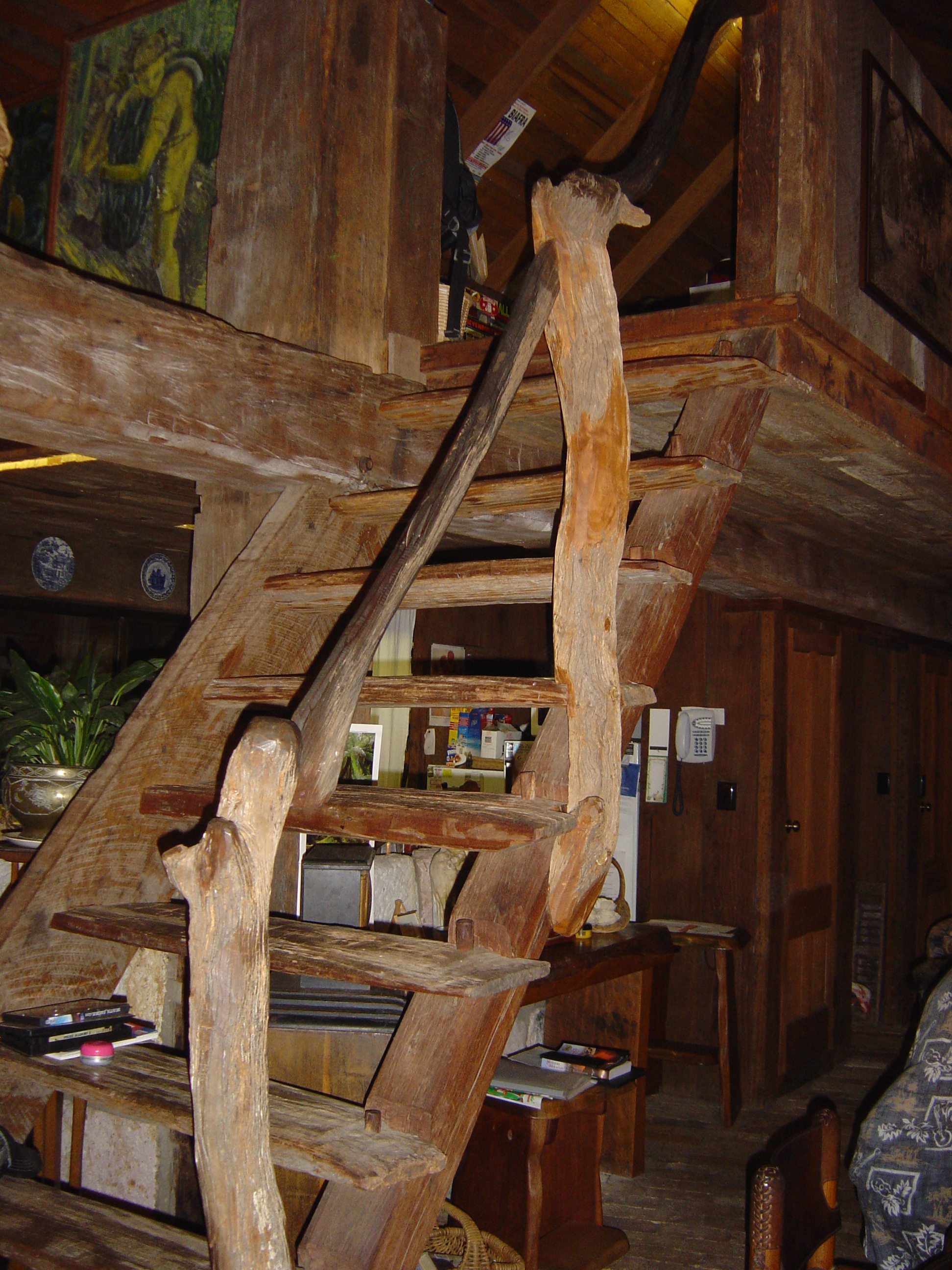
HANDBUILT STAIRCASE: I hand built this staircase myself with the help from a labourer. Four years after we built the house in 1981, we just had an aluminium ladder going from the floor level up to the raised floor. This floor level ran right through to the back western end of the house. The first area was initially a small recessed area which acted as storage area divided off by a small wall. In recent years it was converted into a small office for Anthony my son and now for my daughter who is a qualified primary school teacher. She is still living with us in transition to a place of her own.
The second area is the main area and used to be where my business office was. In 1996 I moved out my office downstairs so that that my table looked out through the glass onto Pond 1 and its surrounding trees.
The third area divided off by another timber wall. It is now a storage area that overlooks the master bedroom.
The staircase was built by hand by initially using two sides of recycled 75 mm thick timbers left over from the house construction. These were securely fastened down to the floor level and up to the raised floor. I then carefully measured the step height and allowed for sufficient steps. I had previously obtained a whole truckload of hand split hardwood slabs I had bought very cheaply off a farmer down at Boonah …. a nearby country town. The farmer had pulled down in 1984, a very old (100 year old) pioneer hut on his land. The rounded bush log rafters and /\ had been eaten out over time by termites. That was how I heard about the slabs through an advertisement in the local paper and I had bought them so cheaply.
With building the steps, I sorted the slabs for any suitable ones for steps. The slabs were then carefully cut out and fitted into the staircase until the whole to the staircase was complete.

STONE WALL CONSTRUCTION: The builder allowed us to have our own separate landscape subcontractor called John for building the stone walls in the living room, kitchen wall and master bedroom wall. Using the porphyry stone blocks from the Supreme Courthouse = 1879, He used an interesting method of bringing the stones in with a bobcat fitted with a set of forks before the glass went in the house. He would initially take a measurement of the space in the wall and go out into the paddock and measure up for a stone that which was of the right width. He would bring it in with the bobcat. The blocks were then drystacked with wooden wedges. These were stacked for grouting on another day. Grout was then pushed into the spaces between the blocks. When the grout hardened, the pegs were pulled out and filled with more grout. In the master bedroom, he used two of the Boggo Rd. stones at the head of the bed so there was a 200 mm ledge for future books.


As written Above:
STONE FROM THE COBB AND CO COMPANY: at time of our building the house, I was passing one day in 1981 down near the corner of Albert and Margaret St. near the Botanical Gardens. I was with my landscape contract business partner at the time, in our truck. We passed a corner block with a big pile of earth and square cut stone. There was a big drott working on the site. We stopped the truck and I went over and asked the driver what he was going to with the stone.
It was from the foundations of the old Cobb and Co. Depot in the Stagecoach days of Brisbane. We were in the middle of building our house. I said to driver, `What do you going to do with the stones?’. He scratched his head and said `I will probably dump them’. `How much do you want for them?’ I asked as the inveterate scrounger. He said `Probably $50.00’. I said `I will give you $75.00 for the lot’. I paid him then and there and had him load on one load of dirty stone. We came back the next day to collect the other load. This is how you recycle waste materials or scrap into useful and very valuable items. Those stones became the main wall in our bedroom and also initially one large one as an inside coffee table.
This was a handcut stone 120 mm. long * 55 mm. wide * 33 mm. deep. In the last three years, the rooms in the house have been redesigned so that now what was initially a dining room has become a small sitting room with the TV and DVD sitting on the raised stone. The stone was moved by hand on bricks and a crowbar with two of us working on the moving of the stone some fifteen metres from one place to the other.
With recent research in the John Oxley Library, I have since found out that the Headquarters of Cobb and Co. were at 71 Albert St., The City. The Company had moved headquarters in 1866 from Melbourne. It had initially been formed to run from Melbourne to the Victorian Goldfields It was in operation in Brisbane for seventy years till 1924. It didn’t survive the Great Depression and caused the Company to go into voluntary liquidation. Competition from rail and the newly invented motor vehicle, had also produced a contracting of the extensive mailruns which ran all over Queensland and down south. At these new headquarters, there were large offices, a coach building factory and stables for the team of horses which drew the coaches. In 1866, the coach building business, was moved to Charleville. It is wonderful to know our stone has been part of early Brisbane history.


…. A . Hanging Mobile made from the Driftwood Sticks etc.
taken from a Beach at Ballina in 2003……

_________________________________________
HOUSE AND GARDEN AS LANDSCAPE SCULPTURE:
I ran a small business in upmarket landscape design and construction for wealthy clients around Brisbane for twenty years. It was called ‘New Earth Systems P/L’. I was an Outer Gardener concerned about Outer Sustainability. I would think and plan the garden around the soil type, the rainfall pattern and the possible degree of maintenance to take the garden 10—20 years into the future. This Outer Sustainability was fragile and easily eroded, dependent on my performance and people’s acceptance of my work.
See some samples of my past work at this website:
Unknowingly, I was a landscape sculptor. I thought of a landscape as a three-dimensional piece of space that people walked through. This space changed with time as it grew and changed with the time of day: shadows vs. sun patterns, boulders, colour, plants, trees, earth-forms, solid structures and water. These were the ingredients in a subtle flow of landscape design and construction. Rather an intangible product to sell and run a business with!! Out of this stage however, I built a structure for my life: my marriage with Harriet, business and the our house plus we had a family of two children. I was more an artist than businessman which caused STRESS.
Harriet and I are into simplicity and recycling. We live in this amazing house built out of
rejects for $32,000.00 in 1981 (28 years ago).
___________________________________________
The Garden Overall:
The Combined House Garden: I planted the garden out in zones flowing out from the house as a total concept that flowed the house in with the surrounding bush and vice versa. Where did house and garden actually finish? ….. they tended to merge in hard landscape and soft landscape. Tall eucalypt trees nearby merged with new low planting to create a series of open flowing rooms off the house. The view of the exterior came into the interior through all the glass of the windows ….. on the outside the bush was reflected in the glass. There were some open spaces and others were closed planted spaces. The open spaces were thinly planted or had low shrubs to look over into the surrounding bush but sometimes they were planted to enclose the spaces as open rooms.
On some of the garden edges I had planted an informal line of storm lily bulbs that would give spontaneous colour with the flowering of lilies after storms. This was characterised in recent times when we had two very big thunderstorms which was a refreshing change to our dry Australian bush and garden for this time of year at our property at Chambers Flat. Within a few days, the numerous dormant storm lilies around the garden began to throw up new pink flower stems out the nest of drab green straplike leaves. Over a few days, the swelling pink bulbous end of the stalks began to swell further to reveal a rolled tubular flower that suddenly unfurled in a day to a soft pink trumpet like flower of indescribable beauty. Six soft pointed petals are expanded towards the sun with varying shades of soft pink and soft white. Each petal was softly streaked with pink from point petal to a whiter centre. A cluster of yellow stamens is at the centre of the corona of petals.
_________________________________________
CONSTRUCTION PROCESS:
It helped as Harriet and I lived onsite in our caravan so I could readily liase with the building supervisor on construction details. This was important as I was supplying the horizontal beams, vertical posts and stone for the internal stone walls plus bricks on the interior concrete slab. It was probably an unorthodox approach but the whole building approach was unorthodox working with nature of the materials. It worked out as a very flexible arrangement for us the client and for the builder.
LOCATION AND HOUSE SITING: I set out the house area so as to be far enough in among the trees of the block so you couldn’t see the house from the road. It was also a question of positioning the house so we didn’t have to take any big trees an in addition minimising the cut and fill of the house site. I marked out the area to be cut with white lime.
HOUSE SITE LEVELLING AND PREPARATION: I hired a drott and cut and filled the site to minimise the cut banks behind the house. As soon as the area was cut, the following sequenced happened:I then hired a mobile crane and laid out all the horizontal beams in a big raft of beams laid out on a number of cross beams on the ground. This then meant that a chain could be thrown around each one and the beam could be singularly relocated.
All beams were sandblasted to remove any white paint or burn marks on the timber. I hired a compressor and bought some white beach sand for the actual blastingBearers were then relocated to the side of the cut so the builder could set the post layout.
POST CONSTRUCTION: The builder then laid out the house with set out of the posts. The builder then hired in a truck mounted posthole borer and dug holes to 2.00 metres down for all the fifteen vertical posts. Then the builder poured the concrete footings beneath the vertical posts. Then the builder allowed us to have our own separate subcontractor for cutting all the horizontal beam slots to the right height.
HORIZONTAL BEAMS: The builder hired a large crane and swung all the Rex Theatre horizontal beams in place. I was onsite directing what beam had to go where. During the construction, one of the beams wouldn’t quite fit in the cut slot so with the expensive crane waiting, I showed the carpenter how to trim 5 mm of the timber down on the bearer with an adze I had onsite. The beam then fitted.
ROOF CONSTRUCTION: The rafters were nailed onto the beams like a big sail settling over the house. Then undressed cypress pine lining was nailed down to the rafters (this had been obtained from Neil my demolition friend at a very good price). After the electrical wiring was completed, the roofing contractor nailed down corrugated iron sheeting over the cypress pine.
FLOOR CONSTRUCTION: The attic floor got nailed down as thick chipboard to eventually be covered with carpet on the top and old recycled fence palings on the underside. These were the looked at ceiling from down stairs in the kitchen, hall and office.
STONE WALL CONSTRUCTION: The builder allowed us to have our own separate landscape subcontractor called John for building the stone walls in the living room, kitchen wall and master bedroom wall. with the porphyry stone blocks from the Supreme Courthouse = 1879. He used an interesting method of bringing the stones in with a bobcat fitted with a set of forks before the glass went in the house. He would initially take a measurement of the space in the wall and go out into the paddock and measure up for a stone that which was of the right width. He would bring it in with the bobcat. The blocks were then drystacked with wooden wedges. These were stacked for grouting on another day. Grout was then pushed into the spaces between the blocks. When the grout hardened, the pegs were pulled out and filled with more grout.
In the master bedroom, he used two of the Boggo Rd. stones at the head of the bed so there was a 200 mm ledge for future books. Interior of the house showing the stone wall of the living room, the bricks on the floor, the big beams, the glass windows looking into the bush, the red cedar timber doors, vertical timber walling and undressed cypress pine ceiling.
INTERNAL WALL CONSTRUCTION: TIMBERS FROM THE WOOL SCOUR SHEDS AT STAFFORD: I scrounged also some timber floor joists (400*300 mm) as wall boarding from the late 1800’s Wool Scour Sheds at Stafford for $0.33 / metre We began a substitution of quoted materials with the builder.
INTERNAL BRICK PAVING: At the same time I scrounged from the Wool Scour Sheds at Stafford in additional to the timber floor joists, a truckload of old recycled bricks for $0.10 each. In 1920 they were originally in the boiler house of the Mt. Crosby Pumping Station then in 1940 they had been recycled into the Wool Scour Shed’s furnace house. Then forty years on in 1981 I recycled them again into the brick paving of our house. They were covered in soft lime cement which I chipped off with a tomahawk.
I was going to have them laid as brick paving in old bricks that flowed over the concrete floor slab in swirling shapes that eventually flowed outside with the future landscape paving. This was by John, the landscape subcontractor The future landscape paving extended the interior paving swirls. The builder supervisor allowed a brick depth recess in the final height of the concrete slab.
SANDBLASTING: The job was nearing completion ….. At the completion of the house, beams, stone and brick floor were sandblasted by another of my subcontractors to remove any dirt and paint left on the beams. One bonus was with the two doors I had used for the broom and linen cupboards facing the living room. I had originally bought these doors for $10.00 each covered in thick blue paint. When they were sandblasted there was beautiful red cedar timber behind the paint. Red cedar was a very prized rainforest timber in the 1800’s used for furniture. It was quickly cut out by the early 1900’s in South East Queensland and Northern NSW.
Another bonus were the old pine terrace doors I had used in the office cupboards (four doors) and the master bedroom cupboards (four doors as well). These had been sent down from the demolition of the Mareeba Hospital on the Atherton Tablelands near Cairns ….. about 1700 kms north of Brisbane. I bought these at the time for $10.00 each as well. When sandblasted, they came up as old hoop pine timber, another valuable rainforest timber of the time.
Sandblasting as a technique is a wonderful process you can use. You aim the thin blast of sand and air at anything it just wipes of the outer layer to give a beautifully picked grain in timber and bricks. Silica dust is a particularly dangerous substance because free silica can cause lung damage. The grit and dust particles must be removed by air blasting, brooming, pressurised water, or vacuum methods. At the end The fine film of sand had to blown out by air blasting.
GLASS WINDOW CONSTRUCTION: Light weight sliding glass doors and windows in bronze anodised frames were fitted in by the builder all around the house. Getting rid of heat is the main problem in S. E. Queensland versus not retaining heat as in other Australian States or overseas. Then the builder allowed us to have our own separate subcontractor to fit special cut glass into either /\ end of the house.
__________________________________________
GARDEN THEMES AROUND THE HOUSE:
__________________________________________
Drainage Ponds Around the House: These fluctuation over time with full water after a lot of rain and dry mud in dryer periods. They have been designed so that the house level on the northern side, cuts into the gently south sloping contour of our land by a slope of two metres. At a later stage, the pond system of four major ponds were cut out.

There are three major ponds on the northern side of the house. The first one receives water which runs off on the side from our graded earth driveway ….see above. This first pond is so levelled that it runs off to the east and overflows into pond 2 which is the background to the lawn terrace out from the house. See photos below.


Pond 4 …. Outside the Master Bedroom: is kept full of water by seepage that comes out of the sand / clay layer about a metre above the water level. We have had much rain in the last few months. We have about 2.00 metres of very sandy soil on our land (from original sandstone) then it becomes very clayey soil. Any subsoil moisture from any rain seeps down through the sandy soil to sit on the clay. Being a sloping block, any subsoil moisture slowly percolates down the slope and emerges at any cut in the slope. The ponds are slowly and continually filled apart from immediate runoff. l
The blue flowered waterlilies grow from dormant seed in the dry mud in the ponds when the area is very dry. I planted some lilies years ago from a nearby waterlily area. When they flower they always set seed in future times when the ponds fill with water.


\___________________________________________
Australian Bush Garden:
___________________________________________
___________________________________________
_________________________________
Pots in the Garden:
___________________________________________
Permaculture Garden:


_________________________________________
Rainforest Garden:
__________________________________________
Hanging Pots:
__________________________________________
Wildlife in the Garden:


__________________________________________
Features in the Garden:

_________________________________________
The Amphitheatre …… Used in Winter time: Constructed from leftover stone from the Supreme Courthouse = 1874 – 79 … in four levels as seats. When in use there foam cushions available. Seats face around a central bonfire for use in the winter time.
![]() |
The Amphitheatre …… is used in winter time when it very cold at night. A bonfire is lit periodically and the amphitheatre can seat around fifty people in a big group.