Hi, my name is Ken Aitken and this website is a compilation of my personal experiences, philosophy, design work, history, stories, and everything in between. I would like to share with you through these few words, photographs, and hyperlinked websites, a three Dimensional experience as though you were actually there with us as an armchair traveller with us.
I sustained a brain injury in 1995 and I have learned to be a Brain Injury Thriver, rather than a Brain Injury Survivor. I learned from that experience that life should be lived with hope, anticipation, and a love of life. Life is AWESOME in every way no matter what happens to you!!
We love people and we believe YOU are an awesome person ….. we think the best of you ….. we want to bring you into a new sense of belonging ….. no matter who you are …. what you look like, how you dress, where you live around the world, what you believe in and how you act that out to the rest of the world.
Because I have your email address, you are part of an informal group around the world called New Earth Community. This is a global Cyberspace Community facilitated by Ken Aitken in Australia. It is about connecting the spaces between people. It is about building community together.
Harriet (my wife) and I believe that everyone should be approached not for what you can get from them but what you can impart into their lives for good in an inner sense. We are here for one another …… I have a component of life that you need and you have a component of life that I need. I call this principle the Sustainable Life and I would like to show you a new sense of belonging and an understanding of an affirmation of identity.
This life is one that has the ability to be continually renewed and maintained. This life has three elements to it:
- Structure gives order, direction, aims and overall purpose
- Spirituality gives ultimate significance. It is the inner room of your life which answers such questions as: Who are we?, What is the meaning of life?, Are we significant?, What values should I live by?, What gives identity and destiny
- Social Network … gives a feeling of belonging… Family & friends, Clubs and Organisations, Associations, Churches, work colleagues
This is discussed in more detail at this post 5. PRINCIPLES OF LIFE: THE SUSTAINABLE LIFE for a Life of Wholeness.
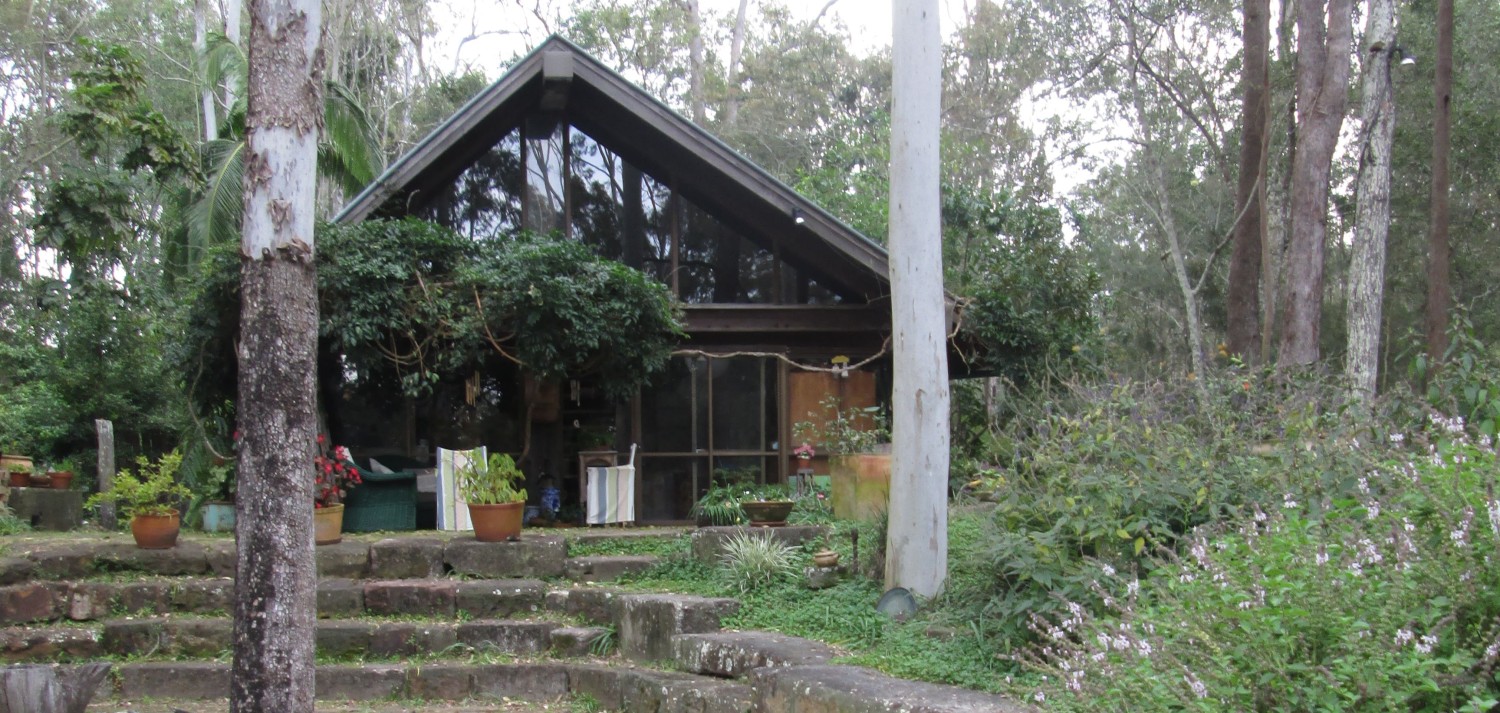
One way my wife Harriet and I live out the concept of Sustainable Life is through the house, land, and space we have created in Logan City, Queensland. In 1981, we built a unique natural house, out of rejected materials for minimal money, on five acres of light open eucalypt bush in Logan City, Brisbane. The house is largely of glass set into a post and lintel construction of 100-year old broadaxed timbers and sandstone walls. The total concept of indoor-outdoor flow has a nice ambiance to it and the design is unique. Where does the bush, the garden and the house end and finish? See these posts:
My wife Harriet and I, also both love to travel and I have documented our trips between 2003- present as a travel blog. We love to see new and often spectacular scenery and geography and each place’s history and it is very profound to us. We love to meet new people in their cultural settings and you realise there are millions of others around the world who live their lives in quite often new ways. People express their ideas on life in the way they build and arrange their living spaces. It is a bit hard to go back to 79 A.D. when Pompeii as a thriving Roman city and was buried with so little warning by 5-6 metre of volcanic ash from Mt. Vesuvius. Pompeii was literally frozen in time.
I would love to hear from you if anything on this website has inspired or interested you. If you would like to connect you can contact me below.
Regards,
Ken Aitken
aitkken@gmail.com
P.S. Suggestions on reading this website: Click on any photograph and it should enlarge to a different size ….. at least half screen or size full screen. It will be clearer in detail than the photo on the post. It will be as if you were really there looking at the actual scene. You are an armchair traveler with us.
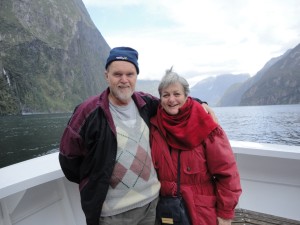
Ken and Harriet on their May 2010 holiday trip to the South Island of New Zealand. This is the Milford Sound section of their trip.